Environmentalists are happy. Developers are happy. Buyers are happy. SANTHA OORJITHAM discovers the real reason for the surge of interest in reducing carbon footprint. CARBON footprints were not a priority when the Amarin Group planned its Amarin Kiara project in 2003.
“We didn’t market it as 'green' because we hadn't been aware at that time of what we could do,” said engineer Andrew Hah.
But today, both developers and buyers are very aware that green buildings are viable. And about 10 to 20 percent of Malaysians and 30 to 40 percent of Singaporean are now asking for green certification, Hah estimated.
With 2 major incentives from the Malaysian government over the past years, developers are happy to oblige.
Amarin Wickham, launched last month, has been given a provisional Green Mark Gold plus rating (the 2nd highest) by Singapore's Building and Construction Authority.

Saw chose a home that will be energy-saving
It was one of the first three developers which the Malaysia Energy Centre (PTM) awarded Suria 1000 grants last year to install Building Integrated Photovoltaic (BIPV) cells. (Individuals homeowners can also apply for such grants, and can get sales and tax exemption via distributors of energy-efficient appliances and solar equipment.)
And Amarin Wickham's consultants are meeting with the Energy, Green Technology and the Water Ministry to find out what benefits and tax incentives the apartments would qualify for under the Green Building Index (GBI) launched in May this year.
Budget 2010 has given income tax-exemption to the cost of obtaining GBI certification (after Oct 24) to building owners, while buyers get stamp duty exemption on the sales and purchase agreements.
Benson Saw calculates that could save him, his brother and sister about RM100,000 each on the 3 units the bought in Amarin Wickham.
But that's not why he's moving in. “What struck me was Amarin Wickham's awareness of our responsibility to our environment.” said the interior designer. He wants to set an example for the next generation by reducing his environmental footprint as much as possible.
His sister is an architect and they could visualise from the layout that with cross-ventilation, the apartments wouldn't need much air-conditioning and that natural lighting would be sufficient during the day. And they will be within walking distance of a shopping mall, a couple of clubs and private schools, so they can save fuel.
Although the apartment will be twice the size of the one his family is living in now, he expects the electricity bill to be about the same, because of the energy-saving lights, air-conditioners, and other appliances.
They will also have maintenance bills about RM500 less than they are now paying because electricity generated by the BIPV cells will be sold back to the national grid and offset against electricity used in the common areas. Even the underground car park will have natural lighting through light tubes during the day.
Hah expects to cut electricity bills for the common areas by half.
Back in 2006, Hah had read the results of the Centre for Environment, Technology and Development Malaysia (Cetdem) 1st comprehensive carbon footprint audit of 50 households in Petaling Jaya including transport. The average family in houses ranging from flats to bungalows consumed 7114 kilowatt/hour (kWh) of electricity per year.
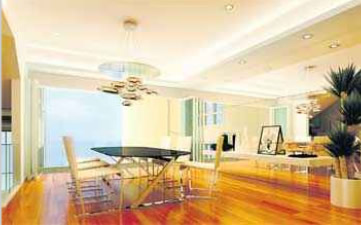
At Amarin Wikham, natural lighting and ventilation will save energy
For every kilowatt/hour (kWh) of energy consumed, an average of 0.69kg of carbon dioxide is released, pointed out Ahmad Hadri Haris, Head of Renewable Energy at PTM. So, if a home uses 1000 kWh per month, it is emitting about 690 kilogrammes of carbon dioxide.
The bulk of the energy used by the households in the study - 75 percent – was for transport, noted Cetdem director Gurmit Singh.
That's why Amarin chose a location close to a bus stop and is within walking distance to several amenities, said Hah.
The biggest electricity guzzlers were air conditioners (44 percent of the electricity, followed by refrigerators using 21 percent), Cetdem found.
Amarin Wickham has used “passive design” to increase energy efficiency. Roof gardens, roof insulation (which Gurmit said reduces heat by 70 percent), deep overhangs above the windows, north-south orientation (to avoid direct sunlight), aerated concrete blocks on perimeter walls, low-emission glazing on windows on the east and west sides, and cross-ventilation will make the apartments cool enough so that residents will not need to use their air conditioners.
And with lots of natural lighting, homeowners will not need to switch on the lights during the day. Low-flow sanitarywares will save water in the apartments while harvested rainwater will be used in the common areas.
Amarin Wickham is using recycled materials in the ceiling boards, kitchen cupboards and wardrobes while 80 percent of the floors will be local merbau with Malaysian Timber Council Certification - assuring that it comes from sustainably managed forest.
Ultimately, it's up to the residents to decide on how much energy they use. Gurmit found during the one year project in 2006 that only a handful of home-owners were willing to use public transport, although more were willing to switch to the energy-efficient appliances and to switch off lights and appliances when not in use.
Equipment on standby consumes 7 percent of electricity in OECD countries, he points out. “The worst culprit is the Astro decoder”, he warned.” If it is on, it consumes 10.8 watts per hour and if it on standby, it's 10.3 watts per hour.”
As part of the British High Commission’s carbon-reduction programme, Sustainable Operation Manager Tang Kok Mun is raising awareness among workers; he organized a composting demonstration, screened Al Gore's An Inconvenient Truth and other motivational films during lunch-breaks. And handed out brochures on what they can do to reduce their electricity bills at home, including reducing the hours of air-conditioning and reducing the temperature of the water heater etc.
“Thermapots are the worst offenders,” he said.” Instead of using these or boiling a kettleful every time you want a cup of coffee, use a small hotpot or boil exactly what you need on a gas stove.”
PTM's Ahmad Hadri urges homeowners to look for energy efficiency rating on appliances such as the 5-star label for refrigerators.
“Avoid switching on light unnecessarily, use a timer to switch off the air-conditioner at night and always close the door to prevent heat getting into the house or cool air from the air-conditioner going out”, he advised. And the best investment is installing solar BIPV cells, he stressed.
Amarin Wickham's Hah agreed, pointing out that: “Electricity and water tariffs will go up with the reduction of government subsidies. Although the conservative estimate is that the cost of BIPV cells will be recovered in 20 to 25 years, I think it could be 5 to 8 years with increased tariffs and lower costs of the cells due to increased supply and demand in the future.”
That's why Tang is helping to reduce the carbon footprint at the British High Commission and in his own home, he said: “Taking action now is cheaper that doing it later.”
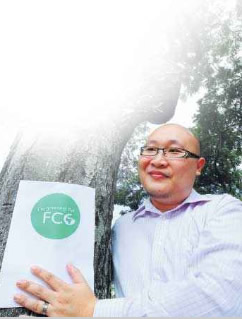
Tang is helping the British High Commision
and its employees to reduce carbon footprint.

